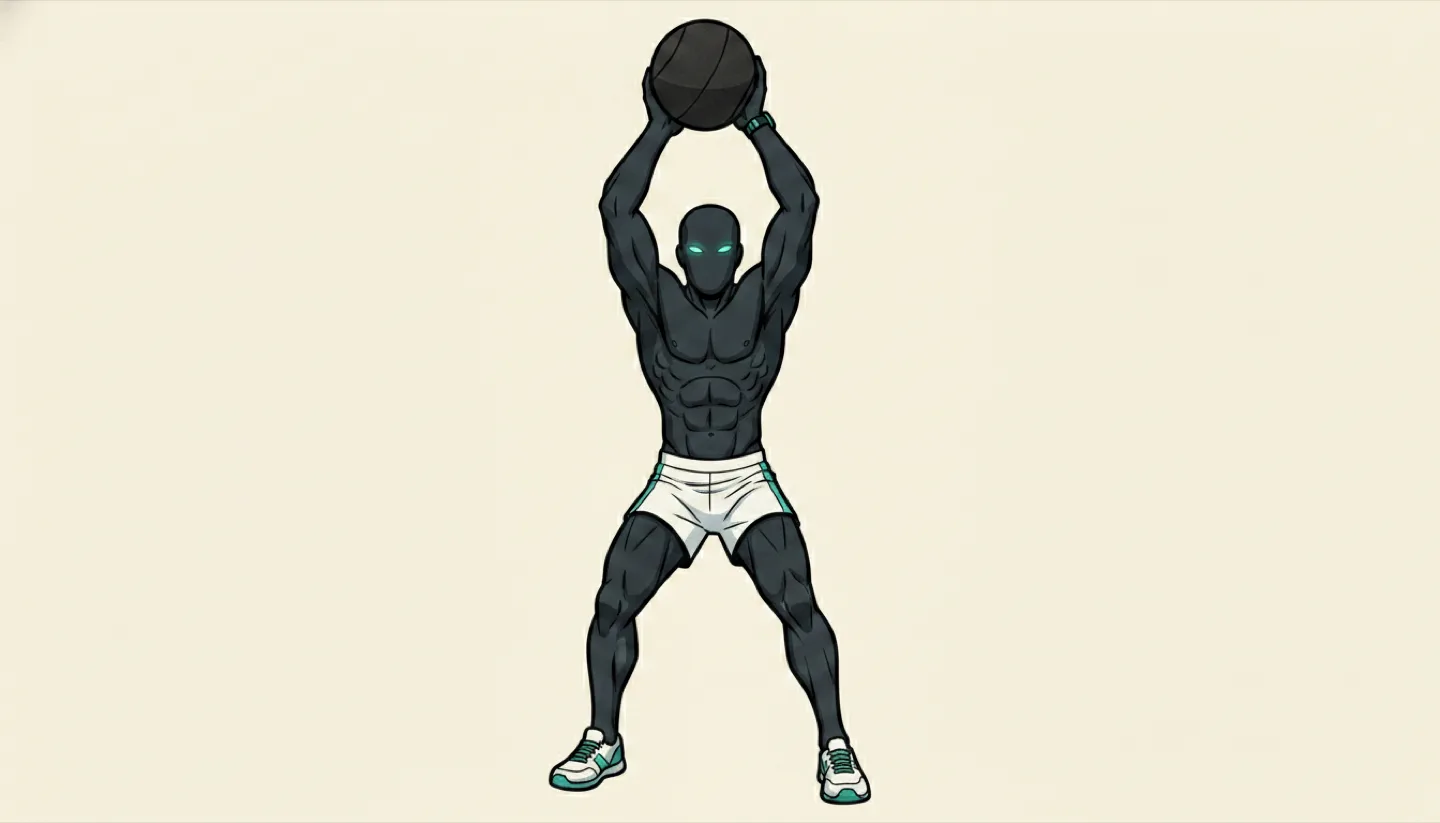
HYROX wall balls are the eighth and final station: 100 reps of a wall ball thrown to a target, and the single most common place a race falls apart. Men throw a 6 kg ball to a 3 m (about 10 ft) target; women throw 4 kg to 2.7 m (about 9 ft). The winning move is almost never going unbroken — it's picking a break-up scheme like 5 sets of 20 or a descending chipper and holding a rhythm you controlled from rep one. This guide gives you the exact break-up schemes with rep targets by ability, the movement standards judges enforce, how to pace so you don't redline, and the no-reps that quietly cost you the race. If you want the bigger picture first, see our take on run-or-lift order for hybrid athletes.
HYROX Wall Balls Break-Up Schemes: The Money Table
The first decision that makes or breaks your HYROX wall balls is how you'll cut up the 100 reps before you touch the ball. Deciding mid-set, gasping, is how the wheels come off. Pick a scheme in training, rehearse it, and commit to it on race day. The table below maps the common break-up schemes to the athlete they suit, with a realistic rep target and station time for each.
| Break-up scheme | Best for | Pros | Cons | Target time |
|---|---|---|---|---|
| Unbroken / 2x50 | Elite, strong squatters | Fastest possible; no transitions | Huge blow-up risk; spikes heart rate | ~4:00-4:30 |
| 4x25 | Competitive athletes | Few breaks, keeps momentum | Sets get ugly if you started too hot | ~5:00-6:00 |
| 5x20 | Most competitive & solid recreational | Even, repeatable, easy to count | Slightly more rest time total | ~5:30-6:30 |
| 10x10 | Beginners, or anyone fried by station 8 | Very manageable; steady breathing | Many transitions add seconds | ~7:00-8:00+ |
| Descending chipper (e.g. 16-15-14…9) | Athletes who fade late | Front-loads work while fresh; sets shrink as you tire | Needs practice to track the count | ~5:30-7:00 |
The rule underneath all of them: breaking the reps into planned sets beats going unbroken and dying at rep 60. Even elites who can go unbroken often choose 2x50 to protect their heart rate for the sprint to the finish. A 20-15-15-... style descending scheme or a clean 5x20 gives the average athlete far more control than heroics.
HYROX Wall Ball Standards: Weight, Height & Reps
The HYROX wall ball standards are fixed at every event worldwide, so there are no surprises on race day. Every division does 100 reps — Women's Open moved from 75 to 100 reps back in September 2024, so 100 is now universal.
- Open Men: 6 kg (14 lb) ball to a 3.0 m (approx. 10 ft) target.
- Open Women: 4 kg (9 lb) ball to a 2.7 m (approx. 9 ft) target.
- Pro Men: 9 kg (20 lb) ball to the same 3.0 m target.
- Pro Women: 6 kg (14 lb) ball to the same 2.7 m target.
Two things worth burning into memory: the target height is set by gender, not division — men throw to 3 m whether Open or Pro, women to 2.7 m — and only the ball weight changes between Open and Pro. The ball is soft and bulky, so grip and catch position matter more than raw strength, especially on the lighter 4 kg and 6 kg balls where the challenge is repeatable accuracy over 100 throws, not moving the load.
Wall Ball Technique: Squat, Drive, Catch, Breathe
Efficient HYROX wall ball technique is one rhythm repeated 100 times — the less you deviate, the less it costs. Break it into four beats:
- Full squat: descend until your hip crease is clearly below your knee. Depth is the standard and the power source — a shallow squat both no-reps you and robs your legs of the stretch that throws the ball.
- Drive with the legs: the ball goes up on leg drive, not a shoulder press. Think of it as a vertical jump you don't leave the ground on; your arms just guide and release.
- Catch and re-load: receive the ball high with soft arms and ride it straight back down into the next squat. A good catch-and-throw rhythm means the ball barely pauses — down, up, down, up — instead of a dead stop every rep.
- Breathe on a pattern: exhale on the throw, inhale on the catch, one breath per rep. The athletes who blow up are usually holding their breath and going anaerobic, not running out of legs.
Stand close enough that the ball travels nearly straight up, not out and away from the wall — every centimetre of horizontal travel is wasted effort you pay for 100 times. This ties directly into your broader race pacing strategy: a smooth, low-effort rep is what makes a break-up scheme survivable.

Pacing HYROX Wall Balls So You Don't Redline
The reason HYROX wall balls wreck races isn't the weight — it's that you arrive at the final station with a maxed-out heart rate and then start too fast. Pacing here is about staying under your redline, not chasing the clock.
- Start deliberately slow. Your first 30-40 reps should feel almost easy. If rep 20 already burns, you went out too hot and the back half will collapse into no-reps and long rests.
- Rest before you need to. Take your planned micro-breaks (3-8 seconds) on schedule, not when you're already failing. A 5-second break at rep 20 is cheap insurance; a 30-second recovery at rep 65 is a disaster you caused.
- Keep rest fixed. Rest the same short count every set rather than improvising — consistency stops the breaks from ballooning.
- Never sprint the transition in. If you red-line on the run into the station, you'll pay it back with interest on the wall.
A useful mental model: it's better to do 5 sets of 20 with 5-second breaks and never miss a rep than to go unbroken to rep 55, gas out, and spend two minutes staring at the ball. Controlled and continuous beats fast and broken every time.
Common HYROX Wall Ball No-Reps (and How to Avoid Them)
A no-rep in HYROX wall balls doesn't add a time penalty — it simply doesn't count, so you throw again to make up the rep. That sounds mild until you realise a fatigued athlete can rack up a dozen of them, effectively adding 10-15 reps of work to an already brutal station. The three that catch everyone:
- Shallow squat: as you tire, your depth quietly creeps up and your hip crease stops dropping below the knee. Judges may place a box behind you to check — if in doubt, sit lower.
- Missing the target line: the ball has to clearly hit at or above the target. Late in the set, throws drift low or catch the edge. Aim to hit the centre of the target with a little margin, not the exact line.
- Incomplete extension: some athletes rush the catch and start the next squat before hips and knees are fully extended at the top.
The counterintuitive fix when the no-reps pile up is to slow down slightly. Deliberately hitting full depth and a clean target on every rep is faster than machine-gunning reps that don't count. One good rep beats two that the judge waves off.
Wall Ball Rep-Count Targets & Times by Ability
Wall balls are one of the highest-variance stations in HYROX — the gap between an elite and a recreational athlete can be 3-4 minutes on this station alone. Knowing where you sit tells you which break-up scheme to rehearse.
- Elite (~4:00-4:30): unbroken or 2x50 with 3-5 second resets. Only attempt this if you can already hit 50+ unbroken in training with clean depth.
- Competitive (~5:00-6:00): 4x25 or 5x20 with disciplined 3-5 second breaks. This is the sweet spot for most serious age-groupers.
- Recreational (~6:30-8:00+): 5x20 or 10x10 with 5-8 second rests, or a descending chipper so the sets shrink as you fade.
Whatever tier you're in, choose a set size you can always hit — a number you'd make even on a bad day — and build up from there. If you're new to hybrid racing, pair this station work with smart weekly programming; our guide to structuring run and lift sessions helps you build the leg endurance wall balls demand without frying your running.
The Bottom Line on HYROX Wall Balls
HYROX wall balls reward planning over grit: 100 reps, a 6 kg ball to 3 m for men or 4 kg to 2.7 m for women, and a break-up scheme you decided on before the buzzer. Pick 5x20 or a descending chipper, hit full depth and the target line every single rep, take your short breaks on schedule, and start slower than your ego wants. Do that and the station that ends most people's races becomes the one where you calmly pass them.
Common questions
How heavy is the HYROX wall ball and how high is the target?
Men throw a 6 kg ball to a 3.0 m (about 10 ft) target; women throw a 4 kg ball to a 2.7 m (about 9 ft) target. In the Pro division the weights go up to 9 kg for men and 6 kg for women, but the target heights stay the same. Every division does 100 reps.
How many HYROX wall balls do you have to do?
100 reps, in every division — Open and Pro, men and women. Women's Open was reduced to 75 reps in the past but moved to 100 in September 2024, so 100 reps is now universal across the board. It's the eighth and final station of the race.
What is the best way to break up 100 HYROX wall balls?
For most athletes, 5 sets of 20 or 4 sets of 25 with short, fixed 3-5 second breaks works best. Beginners can use 10x10, and athletes who fade late can try a descending chipper (16-15-14…). Breaking the reps up almost always beats going unbroken and blowing up mid-set.
Do HYROX wall ball no-reps have a time penalty?
No — a no-rep simply doesn't count toward your 100, so you repeat the throw. There's no added time penalty, but a tired athlete can accumulate many no-reps, effectively adding extra reps to the station. The most common causes are a shallow squat and missing the target line.
Why are HYROX wall balls so hard if the ball is light?
Because they're the final station and you arrive with a near-maxed heart rate after seven other stations and eight 1 km runs. The 4-6 kg ball is manageable in isolation, but 100 continuous squat-throws under full fatigue expose any pacing mistake — most people fail from redlining, not from the load.