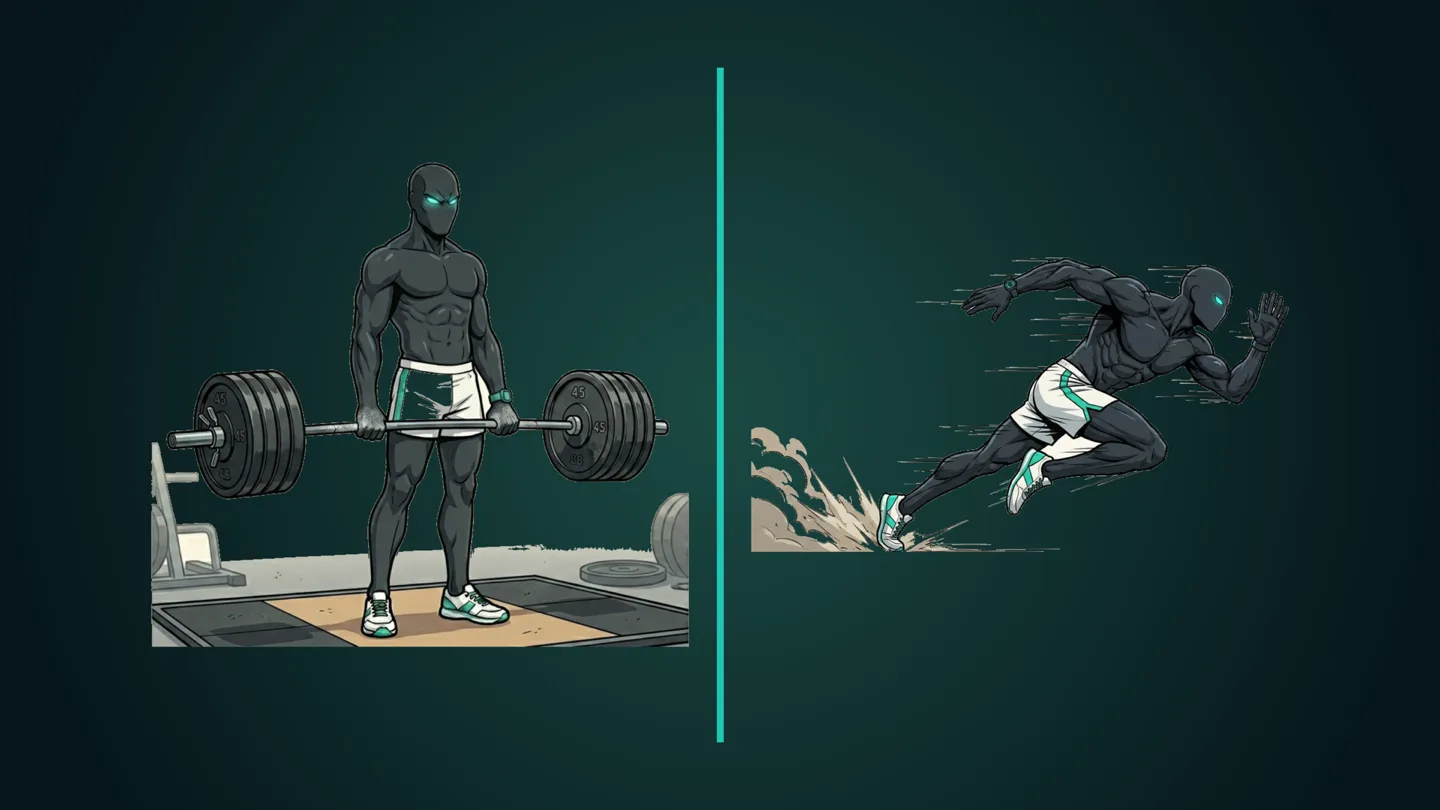
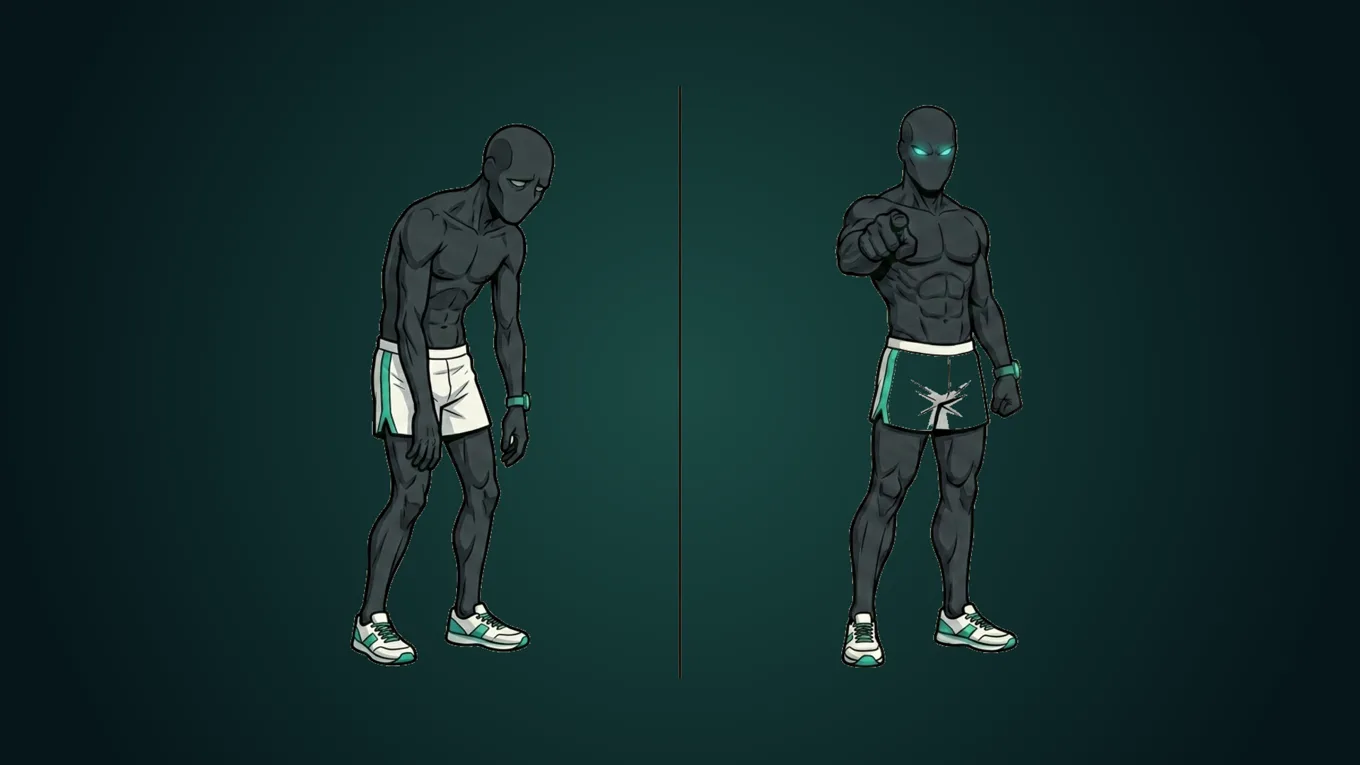
You've been running for months. Maybe years. Your endurance is unreal — you can hold a pace that would put most people flat on the floor. And yet you take your shirt off and you look like a coat hanger someone draped a t-shirt over. Skinny. Soft in the wrong places. "Wait — you're an athlete?" skinny. Here's exactly why that happens, and how to fix it without giving up a single run.
All engine, no body
Let's talk about the mirror moment. You train harder than 95% of people. You grind through long runs that would break normal humans. So why doesn't your body show any of it? Why do the guys who just lift — the ones who'd die at mile two — look more athletic than you, with a fraction of the effort? It feels like a scam. It's not. It's a training problem. And once you see it, you can't unsee it.
The lie you've been told is simple: running is exercise, so running makes you fit. And it does — for one kind of fitness. The mistake is treating "fit" and "muscular" like they're the same thing. They're not even close.
Here's what's happening under the hood. Muscle grows in response to one main signal: tension. Heavy, progressive, getting-harder-over-time tension. That's what tells your body, build more muscle here. Running doesn't send that signal. It sends the opposite one: get more efficient, build a bigger engine, carry less weight. Your body listens — and it gets very good at running by becoming lighter and more economical. Translation: it has zero reason to build muscle it would just have to drag around. So it doesn't.
Then there's the part nobody says out loud: most runners are quietly underfed. You burn a brutal amount of calories, you're not that hungry afterward, and you drift into a small deficit most days without trying. A body running a lot and eating a little holds onto almost no muscle. That's the recipe for skinny-fat — lean arms, soft middle, no shape. And protein makes it worse. Most people wildly overestimate how much they eat. That "high protein" lunch you think is 40 grams? Probably 20. Nowhere near enough to hold muscle, let alone build it.
Why running taxes your muscle
"But won't lifting ruin my running?" That fear is exactly what keeps runners skinny. It's called the interference effect — the idea that strength and endurance cancel each other out. And here's the kicker: for almost everyone watching this, it's wildly overblown. Unless you're an elite chasing seconds, two strength sessions a week won't wreck your running. They'll make it better.
And I need you to hear this part, because most runners never do: base strength isn't the enemy of endurance — it's the foundation of it. Stronger legs don't just look better. They absorb more force, they fatigue slower, they break down less. Strength is what lets your endurance actually show up on race day instead of falling apart in the back half. Skip it, and you're building a fast engine on a frame that's already cracking.
So here's the whole point. You don't have a running problem. You have a missing half. You built a world-class engine and bolted it onto a chassis you forgot to build. The fix isn't to stop running — it's to become a hybrid. Keep the engine, build the chassis. Run and lift. That's the entire secret the skinny-runner crowd refuses to try.
Full honesty — I came at this from the exact opposite end. I was never the skinny runner. I was the guy with the build, the one who'd get winded jogging to the end of the street. And when I said I wanted to run a marathon, everyone — and I mean everyone — told me a guy built like me would never pull it off. Too heavy. Too much muscle. "Stick to lifting." So I forced myself into the uncomfortable half, and I ran 26.2 in under four hours, while keeping the muscle. And I'm not done — I've got three more races in the next twenty weeks, still chasing a faster time. Thirty-thirty is the number in my head, and honestly, I don't know yet if I'll hit it. But that's the point — I'm still building, still on both sides of this. If the guy everybody wrote off can do both, then "I'm too jacked to run" and "I'm a runner, I can't be strong" are the same excuse. Same lie, two directions. Pick up your weak half.

The strength runners keep avoiding
Here's how you actually do it, and it's less than you think.
Two to three strength sessions a week. That's the floor and, for most of you, the ceiling. You don't need to live in the gym — you're busy enough running.
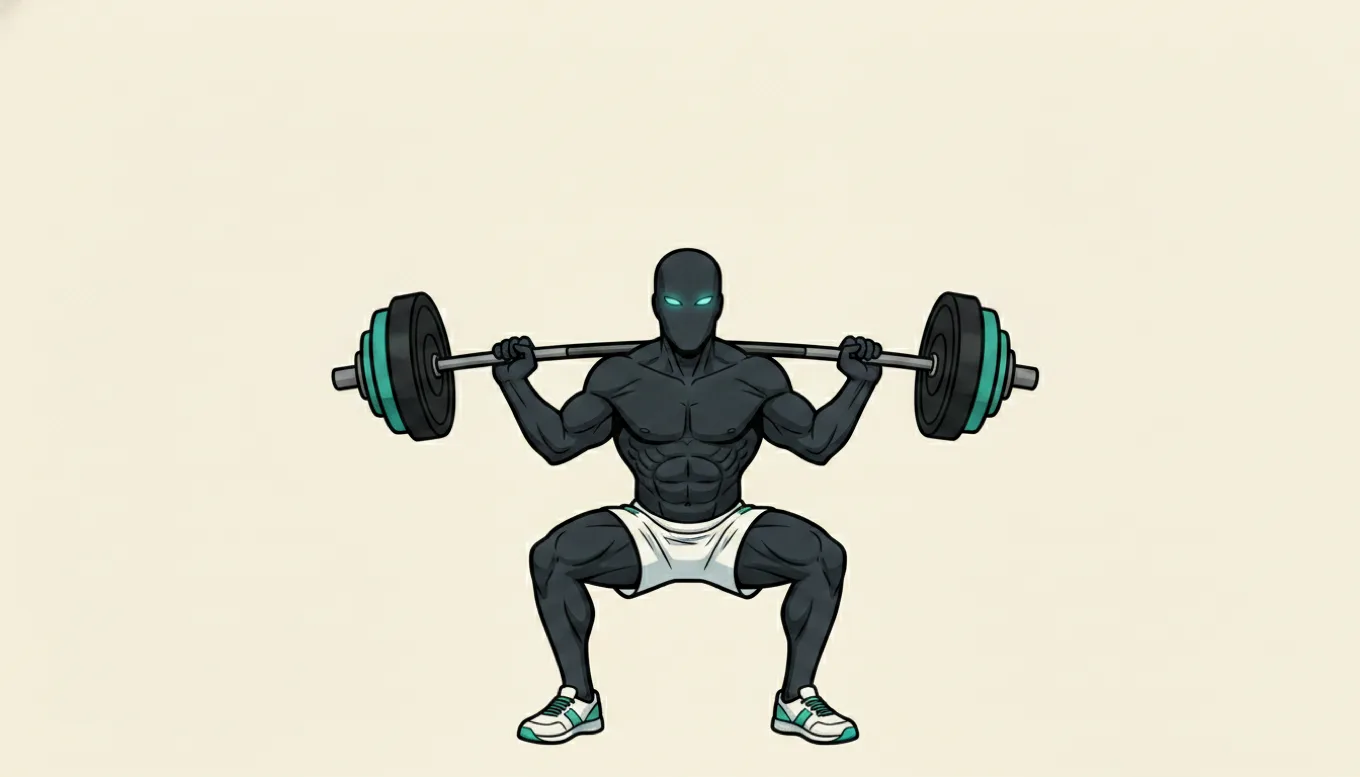
Pick compound movements that train a lot of muscle at once. Got a gym? Squats, deadlifts, presses, rows. No gym? Pull-ups, dips, push-ups, split squats, hard single-leg work. Bodyweight absolutely counts — as long as it gets hard. And that word, hard, is everything. Progressive overload. Every couple of weeks: add a rep, add weight, or pick a harder variation. If your strength training looks identical to three months ago, it's not strength training. It's a warm-up.
Eat for it. Aim for roughly 1.6 to 2 grams of protein per kilo of bodyweight, and stop running yourself into a permanent deficit. You can't build a chassis with no materials.
Look built, still run far
And stack it smart. Don't crush a leg session two hours before your long run. Put hard lifting on easy-run days, or separate them by a few hours. Keep the two from stepping on each other and they start to feed each other — stronger legs make you a more durable, more powerful runner. A simple week: three runs, two full-body strength sessions — one leaning legs, one upper body. That's a hybrid athlete. That's a body that looks like it can do something, because it can.
Now let me be honest about the limits, because everyone selling you a 14-day transformation is lying. This is not fast. You'll be sorer for the first few weeks while your body adapts to a stimulus it's never felt. Your runs might feel heavy for a bit. And if you go stupid — eight gym sessions and ninety miles a week — yes, the interference effect becomes real, and you'll just end up tired and hurt. The game is enough, not maximum. Build the chassis slowly, keep the engine running, let both adapt.
So here's the truth. The skinny-runner look isn't your genetics. It isn't bad luck. It's a training choice — you trained one half of your body and ignored the other. And a choice can be changed. Add two sessions a week, eat enough, lift like you mean it, and in a few months you stop being the runner who looks fragile and start being the one people can't quite figure out. Fast and strong.

Common questions
Why do I look skinny even though I run a lot?
Running tells your body to become lighter and more efficient rather than to build muscle, because it never sends the heavy, progressive tension signal that muscle growth requires. Most runners also drift into a small daily calorie deficit and undereat protein, which produces the skinny-fat look of lean arms and a soft middle.
Will lifting weights ruin my running?
No. For almost everyone except elite athletes chasing seconds, two strength sessions a week won't wreck your running, they'll make it better. Stronger legs absorb more force, fatigue slower, and break down less, so your endurance shows up on race day instead of falling apart in the back half.
How many strength sessions per week should a runner do?
Two to three strength sessions a week is the floor and, for most runners, the ceiling. A simple week is three runs plus two full-body strength sessions, one leaning legs and one upper body.
How much protein should a runner eat to build muscle?
Aim for roughly 1.6 to 2 grams of protein per kilogram of bodyweight, and stop running yourself into a permanent calorie deficit. Most people wildly overestimate their intake, so a lunch you think has 40 grams of protein probably has closer to 20.
What exercises should a runner do to build muscle without a gym?
Pick compound movements that train a lot of muscle at once: squats, deadlifts, presses, and rows in a gym, or pull-ups, dips, push-ups, split squats, and hard single-leg work without one. Bodyweight counts as long as it gets hard, and you must apply progressive overload by adding a rep, weight, or a harder variation every couple of weeks.
How do I combine running and lifting without them interfering?
Don't crush a leg session two hours before your long run; put hard lifting on easy-run days or separate the two by a few hours so they feed each other instead of stepping on each other. The interference effect only becomes real if you go to extremes like eight gym sessions and ninety miles a week, so aim for enough, not maximum.