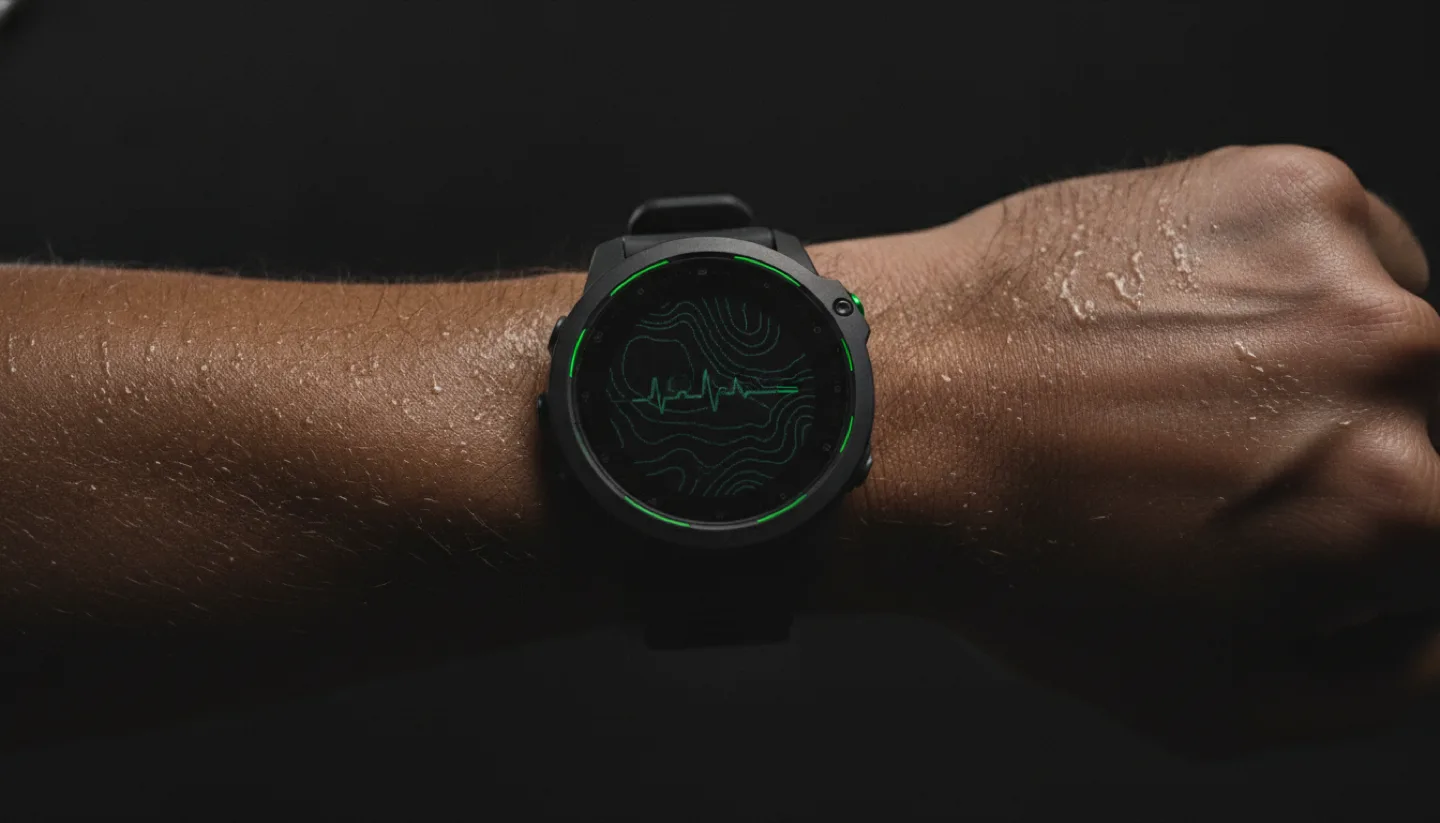
I train hybrid — Ironman-distance triathlon on one side, heavy barbell work on the other — and I've spent real money learning that most fitness watches are built for people who jog twice a week. If you're pushing serious mileage and serious load, the wrist computer you choose decides whether your training data is signal or noise. Here's what actually matters in 2026, walked through my own gear graveyard.
What serious hybrid training actually demands from a watch
A hybrid block is brutal on a watch precisely because it isn't one sport. One day is a 30km long run, the next is heavy squats plus a threshold bike, the weekend is a brick session. That workload sets a hard list of non-negotiables:
- Multi-day battery. If you charge daily you'll eventually start a long run at 12%. I want a week of real use with GPS sessions baked in.
- Dual-frequency (multi-band) GPS. Trees, buildings, canyons — single-band drifts and your pace data lies. Multi-band is the single biggest accuracy upgrade of the last few years.
- True multisport & triathlon modes. Swim-bike-run in one file, with open-water swimming and brick transitions. Non-negotiable if you race tri or HYROX.
- Training load & recovery. Acute vs. chronic load, HRV, sleep — the metrics that stop you overcooking a hybrid week.
- Running dynamics & power. Cadence, vertical oscillation, ground contact and running power for pacing hard efforts.
The data only matters if you use it. I pair pace and load with our HYROX pacing calculator for race splits and the carbs-per-hour calculator to fuel the long stuff — the watch measures, those tools tell me what to do about it.
Why entry trackers — and the Apple Watch — fall short
Cheap trackers and lifestyle smartwatches are optimised for the wrong customer. They're brilliant for step counts and notifications; they fall apart the moment you ask them to be a training instrument. Two problems keep repeating:
- Battery that can't survive a real week. A watch you charge every night is a watch that's dead when you want a 5am long run and forgot the cable. My honest, only-slightly-unfair line: an Apple Watch's battery and its owner share one thing — bad running performance. It's aimed at casual users, and the daily-charge design proves it. I'd never buy one for training.
- Shallow, closed metrics. Entry devices give you a heart-rate graph and a vague "readiness" score, but no proper acute:chronic load, no multi-band GPS, no serious multisport file. You end up guessing.
None of this makes them bad products — it makes them the wrong tool for someone chasing an Ironman PR while adding to a squat.
My real progression: three watches, three lessons
I didn't arrive at my current setup from a spec sheet. I got here by wearing the wrong things first.
Polar Vantage V — the foundation. My first serious training watch. No maps, no touchscreen, but wrist-based running power and Polar's Training Load Pro taught me to respect acute vs. chronic load instead of just chasing mileage. It nailed the fundamentals: structured sessions and honest load tracking. What it lacked was accuracy in hard conditions and modern navigation.
WHOOP — the recovery eye-opener. I wore a WHOOP band for a long stretch and it changed how I think about recovery. Strain, sleep and HRV-driven readiness are genuinely best-in-class, and the screenless band is comfortable 24/7. But be clear about what it is: no screen, no on-board GPS, no maps, and it only works on subscription. It's a superb companion, not a training watch — you still need something on the other wrist to actually run by.
Garmin Forerunner 970 — the one that does everything. This is my current daily driver and the first watch I haven't wanted to replace. It merges what Polar and WHOOP taught me into one device: multi-band GPS, full triathlon multisport, deep training load and recovery, maps on the wrist, and a bright AMOLED I can read mid-effort in the sun.
The honest comparison — Garmin vs Polar vs Coros vs WHOOP
Verified 2026 specs and prices. Battery figures are manufacturer "up to" numbers — real-world is lower, especially in multi-band GPS and with an always-on display.
| Device | Battery (smartwatch / GPS) | GPS | Metrics & recovery | Multisport / tri | Price (2026) | Best for |
|---|---|---|---|---|---|---|
| Garmin Forerunner 970 | ~15 days / up to 26h (≈21h multi-band) | Multi-band | Elite: load, HRV, training readiness, running power | Full tri + brick | $750 / ~€750 | Serious road & hybrid athletes who want everything |
| Garmin Fenix 8 (AMOLED) | up to 29 days / 52–68h | Multi-band | Same as 970 + topo maps | Full tri + expedition | from $999 | Ultra & adventure athletes needing battery + rugged build |
| Polar Vantage V3 / Grit X2 Pro | ~8 days / 43h (140h eco) | Dual-frequency | Excellent load & recovery (Elixir, ECG, SpO2) | Full tri | V3 $599.90 · Grit X2 Pro $750 | Data-driven athletes who trust Polar's science |
| Coros Pace 4 / Apex 4 / Vertix 2S | Pace 4 19 days/41h · Vertix 2S 48 days/118h | Dual-frequency | Strong training hub, leaner ecosystem | Full tri | Pace 4 $249 · Apex 4 $429–479 · Vertix 2S $699 | Best value + huge battery |
| WHOOP 5.0 | up to 14 days / no on-board GPS | Phone GPS only | Best-in-class recovery, strain & sleep | None (companion) | ~$199–359 / yr membership | Recovery focus as a second device |
Brand by brand — who each is actually for
Garmin is the default for a reason: the deepest metrics, the biggest ecosystem, the most reliable multisport. The Forerunner line is the sweet spot for runners and triathletes; the Fenix trades price and bulk for battery, rugged build and expedition mapping. If you can only look at one brand, look here.
Polar punches above its weight on sports science. Training Load Pro, the Elixir biosensor and the recovery tools are genuinely excellent, and the Vantage V3 undercuts Garmin's flagship on price. The ecosystem and maps aren't as polished, but the coaching data is first-rate.
Coros wins on battery and value, full stop. A Pace 4 at $249 does 90% of what a $750 watch does; a Vertix 2S runs for weeks. The software is leaner and the sensor suite less exotic, but for the money nobody's close — especially for new hybrid athletes.
WHOOP isn't a watch and shouldn't be judged as one. As a recovery layer worn alongside a GPS watch it's superb; as your only device it can't run, map or navigate. Buy it as a complement, not a replacement — and know you're renting it.
How to actually choose — by athlete and budget
- Serious hybrid / triathlete, budget open: Garmin Forerunner 970. It's what I wear. Everything, done well, in a package you can read mid-race.
- Ultra, trail or expedition: Garmin Fenix 8 or Coros Vertix 2S — you're buying days of battery and rugged navigation.
- Data nerd who wants Garmin-level science for less: Polar Vantage V3.
- Best value / first serious watch: Coros Pace 4 at $249. Multi-band GPS and a 19-day battery for a quarter of the flagship price is absurd.
- Already own a GPS watch, want deeper recovery: add a WHOOP — just remember it's a subscription and a companion.
My verdict
If you're training hybrid seriously and want one watch to do all of it, buy the Garmin Forerunner 970. It's the culmination of everything my Polar and WHOOP years taught me — accuracy, load, recovery and multisport in one device — and it's the one I actually strap on every morning. If money's tight, the Coros Pace 4 is the smartest value in the sport right now and will not hold your training back. Everything else on this list is excellent for a specific athlete; those two are where most hybrid athletes should start.
Common questions
What's the best running watch for hybrid athletes in 2026?
The Garmin Forerunner 970 is my pick — it combines multi-band GPS, full triathlon multisport, deep training-load and recovery metrics, on-wrist maps and a bright AMOLED display in one device ($750 / ~€750). If budget is tight, the Coros Pace 4 ($249) does most of the job.
Is the Apple Watch good enough for serious endurance training?
For casual fitness, yes. For ambitious hybrid or endurance training, no — the daily-charge battery won't survive long training blocks reliably, and the metrics are shallow compared with a dedicated Garmin, Polar or Coros. It's built for casual users; I wouldn't train on one.
Is WHOOP a replacement for a GPS watch?
No. WHOOP 5.0 has no screen and no on-board GPS — it leans on your phone for location. Its recovery, strain and sleep data are best-in-class, but it's a companion to a GPS watch, not a substitute, and it only works on subscription.
Do I really need dual-frequency (multi-band) GPS?
If you run near trees, buildings or in valleys, yes. Multi-band massively cuts the GPS drift that makes single-band pace data unreliable. It's the biggest accuracy upgrade of recent years and worth prioritising.
What's the best budget GPS watch for endurance?
The Coros Pace 4 at $249. You get multi-band GPS, a ~19-day battery, full multisport and a solid training platform for roughly a quarter of a flagship's price — the smartest value buy in the sport right now.
Garmin Forerunner 970 or Fenix 8?
Get the Forerunner 970 if you're primarily a runner or triathlete — lighter, cheaper, everything you need. Choose the Fenix 8 if you need multi-week battery, rugged build and full topo maps for ultras or expeditions.