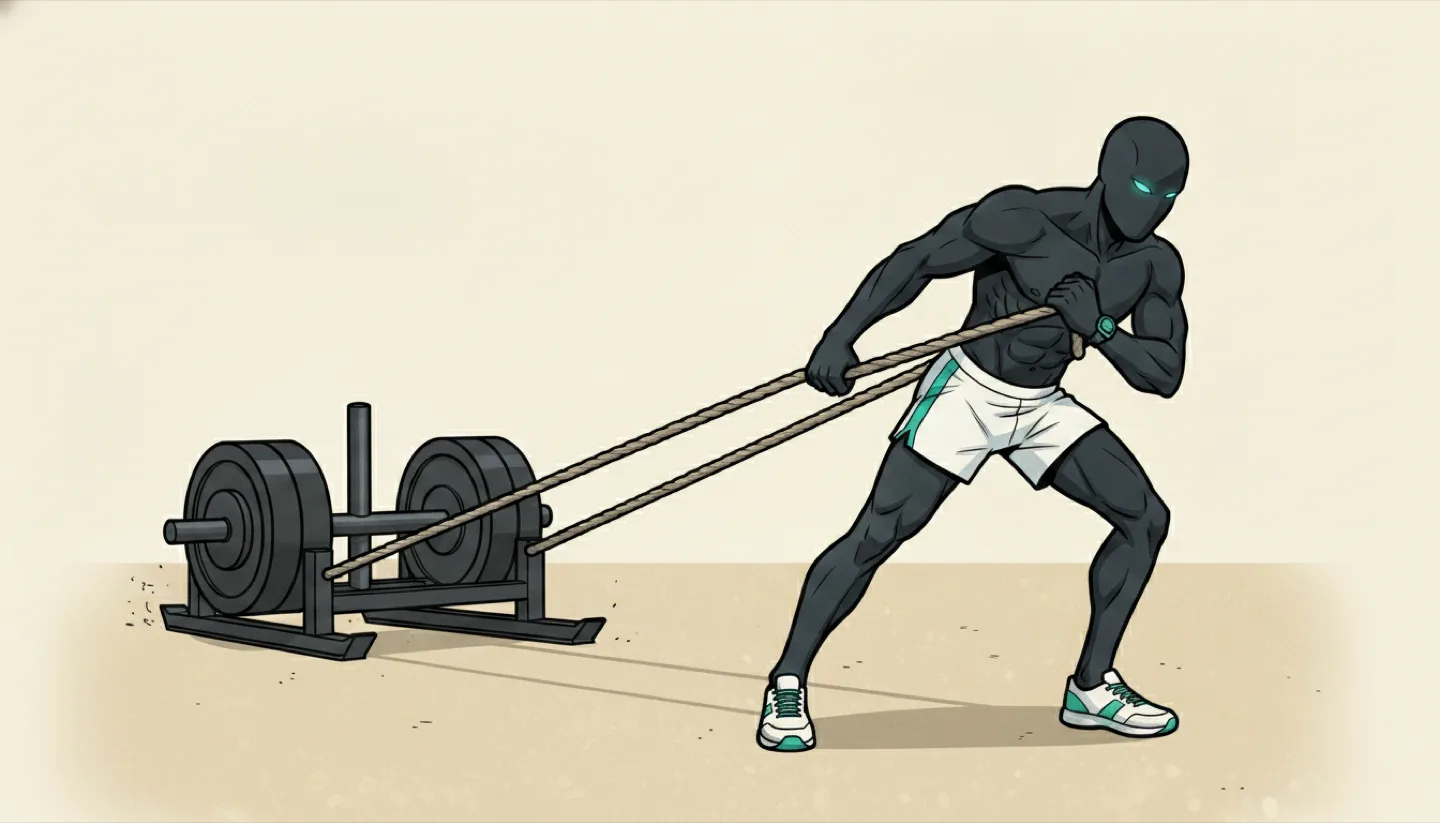
Great HYROX sled push technique comes down to three things: a low 45-degree body lean, fully locked arms, and short, choppy steps that never stop driving. Get those right and most athletes cut 30 to 60 seconds off a station that eats 1:30 to 4:00+ depending on division and floor friction. The sled is the single biggest time-and-heart-rate spike in the race, so how you attack it decides how the rest of your run splits fall apart or hold.
The push is deceptively simple: four lengths of a weighted sled across a turf lane. But the difference between grinders and finishers is almost never raw strength — it's body angle, foot placement and knowing when to break. If you're new to the format, start with what HYROX actually is and how the eight stations chain together, then come back here. And if you deadlift 200kg but redline on the sled, the real culprit is covered in why strong guys gas out — it's an engine problem wearing a strength costume.
HYROX Sled Push Technique: The Definitive Breakdown
The HYROX sled push is the first strength station in the race — 4 lengths of 12.5 metres (50m total) pushing a weighted sled across a turf carpet. Correct HYROX sled push technique is a full-body drive, not an arm push: you lock your elbows, drop your hips, lean your whole body into the poles at roughly 45 degrees, and drive through the floor with short, powerful steps. The power comes from your legs and the ground, not your shoulders.
Here is the non-negotiable checklist that separates a smooth sled from a grind:
- Arms locked straight — bent elbows leak force and pre-fatigue your grip and shoulders.
- Body at ~45 degrees — the more horizontal your torso, the more your body weight and leg drive transfer into the sled.
- Low grip on the poles — hands between hip and chest height so force pushes the sled forward, not up.
- Short choppy steps — 20-40cm strides with high turnover; long lunging steps stall the sled.
- Constant forward pressure — the sled is hardest to restart, so never fully stop unless you've planned the break.
- Head neutral, eyes down the lane — chin tucked, spine long, no craning up.
| Technique Cue | Correct | Common Error | Time/Energy Cost of Error |
|---|---|---|---|
| Body angle | ~45° forward lean | Too upright (70°+) | Loses 30-50% of leg drive |
| Arm position | Fully locked | Bent elbows | Grip/shoulder fatigue, weaker push |
| Grip height | Hip-to-chest, low | High grip (shoulder height+) | Sled rides up, more floor friction |
| Step length | Short 20-40cm | Long lunging strides | Sled stalls between steps |
| Break strategy | Planned segments | Stop when redlined | Restart cost + heart-rate spike |
See how the sled loads compare across divisions in the free HYROX weights calculator, and where the sled fits the full race in all 8 HYROX stations explained.
HYROX Sled Push Weights: Loads by Division 2026
Your HYROX sled push load depends entirely on your division, and the number on the plates is not the number you actually push. The sled itself weighs roughly 52kg (varies slightly by venue), so the total pushed mass is the plate load plus the sled plus turf friction — which is why a 152kg 'total' feels far heavier than a 152kg deadlift. Knowing your exact load lets you rehearse the correct HYROX sled push technique at race weight instead of guessing on the day.
| Division | Added Weight | Approx. Total (incl. sled) | Typical Push Time |
|---|---|---|---|
| Women's Open | 50kg | ~102kg | 2:00-4:00 |
| Men's Open | 102kg | ~152kg | 2:00-4:00 |
| Women's Pro | 102kg | ~152kg | 1:45-3:30 |
| Men's Pro | 152kg | ~202kg | 1:30-3:30 |
| Doubles (split per athlete) | Same as division | Same, shared work | 1:15-2:30 |
Two things drive real-world sled difficulty far more than the plate number: turf friction (fresh, high-pile carpet is dramatically slower than worn turf) and humidity in the venue. The same load can feel 20-30% heavier on a 'sticky' lane, which is why elite splits vary so much event to event. Never assume your gym sled time transfers 1:1 to race day.
Why Body Angle Beats Brute Strength on the Sled
The single biggest lever in HYROX sled push technique is body angle, and it beats raw strength almost every time. When you stand too upright, you push the sled with your arms and upper back and your bodyweight does nothing useful. When you drop to roughly 45 degrees or lower, your entire mass falls into the poles and your legs drive against the floor like a sprinter out of blocks — that's mechanical advantage you get for free.
Think of it as converting your bodyweight into forward force. A 90kg athlete leaning correctly effectively adds a big chunk of that mass to the drive. A 90kg athlete standing upright wastes it fighting gravity vertically instead of pushing horizontally.
- Get your hips low and back angle flat — imagine pushing a broken-down car, not a shopping trolley.
- Drive through the balls of your feet with the ankle, knee and hip extending together.
- Keep the chain rigid — locked arms and a braced core transmit leg power straight to the sled with no energy leak.
- Lower is faster — the closer your torso is to horizontal, the better the force vector, up to the point you can still take steps.
This is why lighter, well-conditioned athletes routinely out-push bigger, stronger ones on the sled: they've solved the angle. If your legs are strong but you gas on the sled, the fix is rarely 'get stronger' — it's fix the lean and build the engine, which ties directly into why strong guys gas out in hybrid events.
Grip, Hand Position and Foot Placement
Small setup details make or break your HYROX sled push before you've even moved a metre. The sled has two vertical poles; where and how you grip them changes your entire drive angle. Correct HYROX sled push technique starts with a low grip between hip and chest height — high hands let the sled tip up and jam into the turf, spiking friction.
- Grip low, not high — hands around hip-to-lower-chest level keep your force horizontal.
- Full grip, arms locked — some athletes push with an open palm/heel of the hand on longer poles; whatever you use, keep elbows straight.
- Feet staggered but active — no long static lunge; you want quick alternating drive, not a held split stance.
- Stay on the balls of your feet — heels lightly down for stability, but drive comes from the forefoot.
- Hips behind hands — your centre of mass should sit behind the poles so you're pushing forward-through, not down-into the sled.
| Setup Element | Recommendation | Why It Matters |
|---|---|---|
| Grip height | Hip to lower chest | Keeps sled flat, reduces friction |
| Elbow position | Locked straight | No force leak, saves grip/shoulders |
| Foot contact | Balls of feet | Maximises drive and turnover |
| Stride length | Short (20-40cm) | Keeps sled moving continuously |
| Centre of mass | Behind the poles | Directs force horizontally forward |
5 Most Common HYROX Sled Push Mistakes
Most lost time on the HYROX sled push comes from a short list of repeatable errors — fix these and you'll bank 30-60 seconds without getting a gram stronger. Every one of these is a technique or pacing fault, not a strength ceiling, which means the fix is fast. Cleaning up your HYROX sled push technique here is the highest-ROI change most athletes can make.
- Standing too upright — the #1 error. You lose most of your leg drive and turn a leg exercise into a shoulder grind.
- Bending the arms — bent elbows pre-fatigue your grip and delts, both of which you need for wall balls and farmer's carry later.
- Long lunging steps — big strides let the sled decelerate and stall between each push; you then waste energy re-accelerating it.
- Gripping high — high hands tilt the sled up, increasing turf contact and friction.
- Unplanned stopping — quitting mid-length when you redline forces a costly restart; the sled is 2-3x harder to start than to keep moving.
| Mistake | Fix | Estimated Time Saved |
|---|---|---|
| Too upright | Drop to 45° lean | 15-30s |
| Bent arms | Lock elbows | 5-15s + saves grip |
| Long strides | Short choppy steps | 10-20s |
| High grip | Grip hip-to-chest | 5-15s |
| Random stops | Plan your breaks | 10-30s |
How to Pace and Break the Sled Push
Pacing is where the HYROX sled push is won or lost, because the sled punishes bad decisions more than any other station. The rule: plan your breaks before you start, and break before you redline — never after. A stopped sled is 2-3x harder to restart than a moving one, so an unplanned collapse mid-length costs you far more than a planned pause at the end of one. Smart HYROX sled push technique is as much about breathing and segmenting as it is about body angle.
Match your break strategy to your division and conditioning. Here's a practical framework for the 4x12.5m:
| Athlete Level | Suggested Segments per Length | Rest Style | Target Sled Time |
|---|---|---|---|
| Beginner | 2-3 pushes + short resets | 3-5 breaths, hands on sled | 3:00-4:00 |
| Intermediate | 1-2 pushes per length | 2-3 breaths at turns only | 2:00-3:00 |
| Advanced | Unbroken lengths | Turn-arounds only | 1:30-2:15 |
| Elite/Pro | Continuous, minimal reset | None between lengths | 1:15-1:45 |
- Break at the end of a length, not the middle — the turn already forces a reset.
- Keep hands on the sled during breaks — resetting your grip and stance from scratch wastes seconds.
- Breathe in a fixed pattern — e.g. exhale sharply every 2-3 steps to control heart rate.
- Remember the run after — you sprint straight into a 1km run, so don't bury yourself so deep on the sled that your legs are jelly.
HYROX Sled Push Benchmark Times to Aim For
Knowing realistic benchmark times lets you judge whether your HYROX sled push is a genuine weakness or just feels hard because it's supposed to. Below are practical target ranges for the full 4x12.5m sled push by ability and division. Use them to set a goal split, then reverse-engineer the pacing and HYROX sled push technique needed to hit it.
| Level | Men's Open (~152kg) | Women's Open (~102kg) | What It Signals |
|---|---|---|---|
| Beginner | 3:30-4:30 | 3:30-4:30 | Technique/engine work needed |
| Recreational | 2:30-3:30 | 2:45-3:45 | Solid, keep refining |
| Competitive | 1:45-2:30 | 2:00-2:45 | Strong sled, good angle |
| Elite/Pro | 1:00-1:45 | 1:15-2:00 | Race-winning territory |
Two caveats before you judge yourself: first, these are highly venue-dependent because of turf friction, so compare like-for-like events. Second, the sled split matters less in isolation than what it costs you — a 10-second-faster sled that leaves you unable to run the following kilometre is a net loss. Train the sled as part of the chain, never as a standalone lift. For a structured plan that sequences sled work with your runs, use the HYROX training plan generator to auto-build your weeks.
How to Train the Sled Push to Get Faster
Getting faster on the HYROX sled push requires two separate qualities trained on purpose: maximal leg drive (the ceiling) and aerobic capacity under load (your ability to actually use that ceiling when your heart rate is at 180). Training only heavy pushes gives you a big engine you can't sustain; training only light intervals gives you endurance with no power. You need both, and you should rehearse race-weight HYROX sled push technique regularly so it's automatic on the day.
- Heavy sled pushes — 4-6 sets of 15-20m at 100-120% of race weight, full rest. Builds the strength ceiling.
- Race-pace intervals — push race weight for 50m, then immediately run 200-400m; repeat 4-6 times. This is the money session.
- High-turnover sprints — light sled, 10-15m, maximum step frequency. Grooves the short-choppy-step pattern.
- Leg-drive accessories — heavy sled work aside, add walking lunges, split squats, and hip thrusts for unilateral drive.
- Grip and core — dead hangs and planks so bent-arm fatigue never forces you upright.
| Session Type | Load | Distance/Reps | Primary Adaptation |
|---|---|---|---|
| Heavy sled | 100-120% race | 15-20m x 4-6 | Max leg drive |
| Sled + run combo | ~100% race | 50m sled + 200-400m run x 4-6 | Race-specific capacity |
| Turnover sprints | 40-60% race | 10-15m x 6-8 | Step frequency |
| Leg accessories | Moderate-heavy | 3-4 x 8-12 | Strength base |
Frequency: 1-2 dedicated sled sessions per week is plenty for most athletes, ideally with the combo session as the non-negotiable. If you don't have sled access, hill sprints and heavy prowler-style leg-drive substitutes carry over well.
Sled Push vs Sled Pull: Don't Confuse the Two
HYROX has two sled stations and athletes routinely muddle them, so it's worth being explicit: the HYROX sled push is station one (drive it away from you) and the sled pull is a later station (haul it toward you with a rope). They demand opposite mechanics, so the HYROX sled push technique cues here do not transfer to the pull — mixing them up wastes training time.
| Attribute | Sled Push (Station 1) | Sled Pull (Station 5) |
|---|---|---|
| Direction | Push away, forward lean | Pull toward you, rope |
| Prime movers | Quads, glutes, calves (leg drive) | Back, biceps, grip (pull chain) |
| Body position | 45° forward lean, locked arms | Seated-back lean, hand-over-hand |
| Key limiter | Leg power + angle | Grip + back endurance |
| Common error | Standing too upright | Pulling with arms not legs/back |
- Push = legs and lean; pull = back, grip and a rhythmic hand-over-hand rope drag.
- Train them separately — a strong push does not make a strong pull, and vice versa.
- Both reward technique over strength — angle and rhythm beat brute force on each.
Race-Day Sled Push Strategy and Warm-Up
Your HYROX sled push is the first strength station, hit early while you're relatively fresh but already warm from the opening 1km run — so your race-day plan matters. The mistake is going out too hard because you feel strong, then paying for it across the remaining seven stations. Disciplined HYROX sled push technique and pacing here protects the whole back half of your race.
- Prime the pattern in warm-up — do 1-2 short pushes at moderate load before the race so the movement is grooved, not cold.
- Walk your lane if allowed — feel the turf friction so you know whether it's a fast or sticky floor.
- Start controlled, finish strong — the sled is early; don't empty the tank on length one.
- Protect your run legs — you sprint into a 1km run immediately after, so the goal is a fast sled that leaves you able to run.
- Set your break plan before you touch the poles — decide your segments in the warm-up, not while gasping mid-length.
| Race Phase | Action | Goal |
|---|---|---|
| Warm-up | 1-2 primer pushes | Groove the movement |
| Recon | Feel turf friction | Set realistic split |
| Length 1-2 | Controlled, planned segments | Bank pace without redlining |
| Length 3-4 | Hold form, push through | Finish strong, save run legs |
Zoom out and the sled is one link in an eight-station chain interspersed with eight 1km runs — pace it like a chapter, not the whole book. New to the full format and how the stations sequence? Ground yourself with what HYROX is before you fine-tune any single station.
Common questions
What is the correct HYROX sled push technique?
The correct <strong>HYROX sled push technique is a 45-degree forward lean with fully locked arms, gripping the poles low (hip-to-chest height), and driving with short, choppy steps</strong>. Power comes from your legs and the floor, not your arms — keep constant forward pressure so the sled never fully stalls.
How heavy is the HYROX sled push?
The <strong>HYROX sled push adds 50kg for Women's Open, 102kg for Men's Open, and up to 152kg for Men's Pro</strong>, plus the ~52kg sled itself. So Men's Open pushes around 152kg total. Turf friction and humidity can make the same load feel 20-30% heavier on race day.
Why do I gas out so fast on the HYROX sled push?
You most likely <strong>stand too upright and push with your arms instead of driving with your legs at a 45-degree lean</strong>. That turns a leg exercise into a shoulder grind and spikes your heart rate. Fix the body angle, lock your arms, and pace with planned breaks before you redline.
How long should the HYROX sled push take?
A recreational athlete should target <strong>2:30-3:30 for the full 4x12.5m sled push, while competitive athletes hit 1:45-2:30 and elites go under 1:45</strong>. Times swing heavily with turf friction, so compare only against similar venues rather than a fixed number.
Should I break the HYROX sled push or push it unbroken?
<strong>Plan your breaks before you start and break at the end of a length, never mid-push when you redline.</strong> A stopped sled is 2-3x harder to restart than a moving one. Beginners take 2-3 segments per length; advanced athletes push lengths unbroken and rest only at turns.
How do I train to get faster at the HYROX sled push?
<strong>Combine heavy sled pushes (15-20m at 100-120% race weight) with race-pace sled-plus-run intervals (50m sled then a 200-400m run).</strong> Heavy work builds leg-drive ceiling; the combo session builds the aerobic capacity to use it under fatigue. One to two focused sled sessions per week is enough.