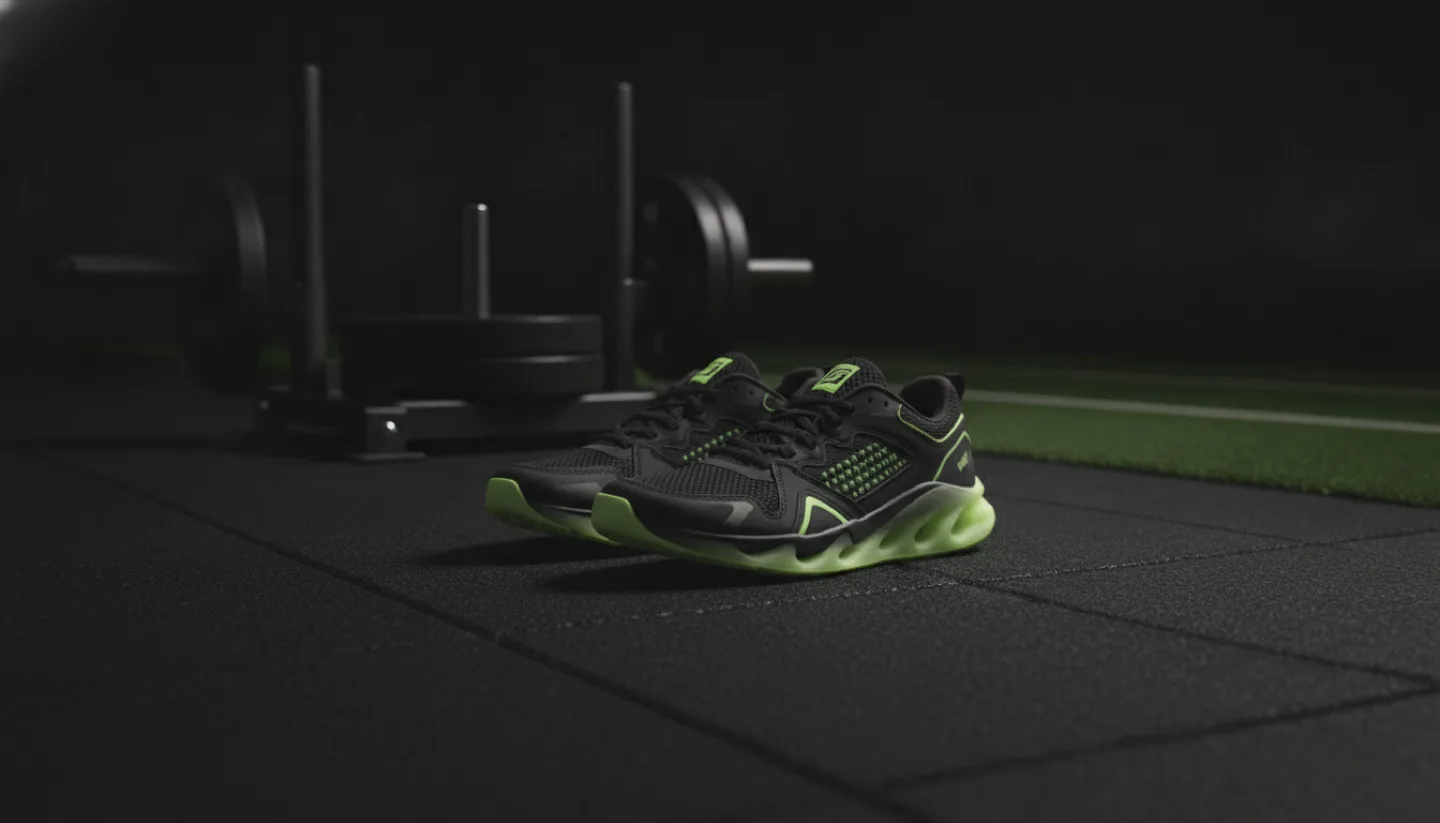
Here's the trap with HYROX shoes: the race is 8 km of running chopped up by eight strength stations, and the two halves want opposite things from a shoe. Running shoes are light and springy but slide on the sled track. Gym shoes grip like glue but feel like bricks by kilometre five. Choosing the best HYROX shoes for 2026 is really about deciding which compromise you can live with — and that comes down to one question: are you a runner who lifts, or a lifter who runs?
The HYROX shoe problem: one pair, two opposite jobs
Unlike a CrossFit workout where you can change shoes between events, HYROX is run in a single pair from the first metre to the last wall ball. That one rule is why shoe choice matters so much — you can't cheat the compromise.
Look at what the race actually asks. You run eight 1 km efforts, roughly 8 km total, which rewards a light, cushioned, energy-returning shoe. In between sit the stations: SkiErg, a brutally heavy sled push, a grinding sled pull, burpee broad jumps, the row, farmers carry, sandbag lunges and 75–100 wall balls. Those demand a stable, planted platform and an outsole that bites on rubber flooring and turf so you don't slip mid-push.
Those two profiles fight each other. A tall, plated super-shoe that flies on the run gets tippy and vague under a loaded sled. A wide, grippy trainer that anchors the sled feels dead and heavy over 8 km. There is no shoe that wins both — every pick on this list is a bet on which side of your race is losing you the most time.
The official answer: PUMA Deviate NITRO Elite HYROX
PUMA has been tied to HYROX since the sport's very first race in Hamburg in 2017 and is now its official global footwear and apparel partner — a deal recently extended through 2030 — so it makes sense they built the first shoe engineered specifically for it. The PUMA Deviate NITRO Elite HYROX launched globally on 19 February 2026 at around $260 / €260, with a fresh colourway rolling out around the 2026 World Championships in Stockholm.
The spec sheet is a genuine attempt to solve the trade-off above: adapted NITROFOAM Elite for energy return, a full-length carbon-fibre PWRPLATE for propulsion, and — the clever bit — a full-coverage, high-traction PUMAGRIP outsole with a lug pattern designed for multi-surface control, so it grips the sled track better than a normal road racer. It's the shoe PUMA's sponsored elite roster races in.
Read it clearly for what it is, though: this is an elite race-day super-shoe. A full carbon plate under a soft, tall midsole is built for chasing a podium time, not for a first-timer who is going to grind out heavy lunges and needs stability more than propulsion. For training — and for most age-groupers on race day — the cheaper PUMA Deviate NITRO 4 (around $170, 250 g, 38/30 mm stack, 8 mm drop, and available in a Wide) is the more sensible companion.
Best HYROX shoes 2026 at a glance
| Shoe | Best for | Why | Approx. price |
|---|---|---|---|
| PUMA Deviate NITRO Elite HYROX | Racing the clock | Purpose-built: carbon plate, PUMAGRIP outsole | $260 |
| PUMA Deviate NITRO 4 | Training + all-rounders | Same DNA, far cheaper, comes in Wide | $170 |
| HOKA Mach 7 | Runner-types who want grip | Sticky-rubber outsole, well above-average traction | $140 |
| Nike Metcon 9 | Strength-types | Flat, stable, superb grip — poor over 8 km | $150 |
| adidas Dropset 3 / Elite | Sled-and-lunge specialists | Lightstrike heel, firm forefoot; closest to HYROX-specific | $150–200 |
| Altra Experience Flow 3 | Wide feet + runner-types | Huge FootShape toe box, low 4 mm drop, smooth ride | $140 |
Prices are typical US retail and vary by region and colourway.
If you're a runner who lifts
If your splits fall apart on the second half of the run while the stations feel manageable, buy a running shoe first and accept slightly worse grip. Your time is bleeding out on the track, not the sled.
The trick is picking a running shoe with an above-average outsole rather than a slick racing flat. Standouts for 2026:
- HOKA Mach 7 — a light daily trainer with a genuinely sticky rubber compound, which is exactly what you want when you're pushing a sled in a shoe that also has to run.
- PUMA Deviate NITRO 4 — the plated feel of the race shoe without the elite price, and the Wide option covers a lot of feet.
- Saucony Endorphin Speed 5 — huge energy return if the running is your whole game and you're strong enough on the stations to get away with less grip.
Match the shoe to a realistic run target. Plug your goal into the HYROX pacing calculator and the race fuel calculator so you know whether you actually need a plated shoe or just consistent legs and better fuelling.
If you're a lifter who runs
Flip it. If the sled push, the pull, the lunges and the wall balls are where you leak minutes — and the run is just survival — buy for grip and stability and pay the tax on the run.
- Nike Metcon 9 — flat, firm, planted, with an outsole that doesn't budge under load. The catch is honest: it is a poor tool for 8 km of running, so only go here if your run is short and slow anyway.
- adidas Dropset 3 / Dropset Elite — adidas built these for exactly this athlete, with a softer Lightstrike heel for a bit of run comfort and a firmer forefoot for pressing into the floor. In 2026 it's about the closest thing to a HYROX-specific training shoe outside PUMA's Elite.
- NOBULL Drive — low, grounded and stable if you want a minimal platform under heavy loads.
Know your numbers before you commit to this side. If your sled and station weights are what's really slowing you, the HYROX weights calculator tells you exactly what you'll be moving so you can decide how much grip you truly need.
My real pick for wide feet: the Altra Experience Flow 3
Time to be honest about the lens I'm looking through. I'm a hybrid athlete training for an Ironman while lifting heavy — deadlift 160 kg for six, back squat 120 kg for six — and I have wide, large feet. For me, most 'performance' running shoes fail for one boring reason: they crush my forefoot. A locked-down, tapered toe box wrecks a long run no matter how good the foam is.
So I run in the Altra Experience Flow 3, and I rate it at the top specifically for the running. Altra's whole identity is the foot-shaped, natural ride, and this model pairs the signature wide FootShape toe box — my toes finally get to splay on the back half of a long run — with a low, near-natural 4 mm drop, a 32/28 mm stack and the soft new EGO P35 foam. It's smooth, it's roomy, and it's the first shoe in a while that hasn't punished my feet on high mileage.
Be clear about the trade-off, because I promised honesty: this is a road-running shoe, not a sled specialist. The outsole is good daily-trainer rubber, not the tacky compound of a Metcon, and the wide base gives you stability through your natural foot rather than through a stiff plate. If your race is won at the stations, this isn't your shoe. If, like me, the running is your strength and your feet are wide, it's excellent.
For contrast, I tried the Asics Gel-Kayano — a fine shoe for a lot of people — and it was flat-out wrong for my feet: too structured, too narrow through the forefoot, no room to splay. Great cushioning I couldn't enjoy because my foot was fighting the upper the whole way.
How to actually choose: the buy framework
Skip the hype and run the decision like this:
- Find your weakness. Where does the clock hurt most — the run or the stations? Buy for that half, because you only get one pair.
- Runner who lifts → a light running shoe with a grippy outsole (HOKA Mach 7, PUMA Deviate NITRO 4).
- Lifter who runs → a stable, tacky platform (Nike Metcon 9, adidas Dropset) and accept a slower run.
- Wide or large feet → start with foot-shaped fits (Altra Experience Flow 3) or the explicit Wide versions brands now offer, like the Deviate NITRO 4 Wide. Fit beats every spec on the box.
- On a budget → you do not need the $260 Elite unless you're chasing a podium. A solid grippy trainer covers 90% of athletes.
Two numbers make this decision for you. Check where you actually rank with the HYROX percentile calculator, and pin down the exact loads you'll be grinding through with the HYROX weights calculator. Once you know whether your race is a running problem or a strength problem, the right shoe on this list is obvious.
Common questions
Do I really need special HYROX shoes?
No — you can finish a HYROX in any decent trainer. But because you run 8 km and work eight strength stations in a single pair with no swaps, the right shoe genuinely saves time: better grip on the sled or a lighter ride on the run, depending on your weakness. It matters more the faster you get.
Can I use one shoe for both the running and the sled?
You have to — HYROX rules mean you race the whole thing in one pair. That's the entire reason shoe choice is a compromise. Pick the shoe that fixes your bigger weakness and accept it's slightly worse at the other half.
Is the PUMA Deviate NITRO Elite HYROX worth $260?
If you're chasing a competitive time and want the official, purpose-built race shoe with a carbon plate and full-coverage PUMAGRIP outsole, yes. For most age-groupers and for all your training, the Deviate NITRO 4 at around $170 gives you most of the feel for far less money.
What are the best HYROX shoes for wide feet?
Start with foot-shaped brands and explicit Wide versions. As a wide-footed runner I rate the Altra Experience Flow 3 highly for its huge FootShape toe box and low 4 mm drop, especially for the running portion. PUMA also sells the Deviate NITRO 4 in a Wide. Avoid narrow, structured stability shoes like the Asics Gel-Kayano if your forefoot is broad.
Do I need a carbon plate for HYROX?
No. A carbon plate helps the running feel fast but adds stiffness and a touch of instability under heavy sled and lunge work. Beginners and strength-type athletes are usually better served by a flatter, more stable, grippier shoe than by a plated super-shoe.
Metcon or a running shoe for my first HYROX?
If your run is slow and short and the stations scare you, a Metcon-style grip shoe will feel safer. But for most first-timers the running is the bigger time sink, so a comfortable, grippy-ish running shoe you can actually cover 8 km in is the smarter default.